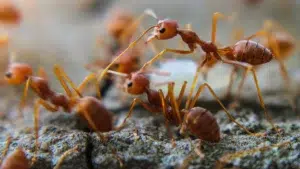


Wondering how to get rid of fire ants in your yard? It all starts with treating your entire lawn with fire ant bait, followed by spot-treating mounds that are still active a few days later.
Many North Texans don’t pay attention to timing. But the bait only works when ants are hungry and out looking for food, which means warm, dry days in spring and fall. Spread it at the wrong moment and you’ll have a failed fire ant treatment.
And even when you do everything right, fire ants tend to come back. The long warm seasons, soaking spring storms, and heavy clay soil in Collin County all provide ideal conditions for fire ants. So the real goal isn’t one big victory. It’s fire ant control that lasts.
Make Sure They’re Really Fire Ants
Before starting any treatments, you have to confirm what you’re dealing with. Plenty of native ants in Texas are harmless, and some even compete with fire ants for space.
For example, red imported fire ants (i.e., “red fire ants”) are easy to spot:
- No center hole. Their mounds are fluffy domes of loose soil. Ants come and go through underground tunnels, not a doorway on top.
- They build after rain. A lawn that looks fine one day can have new mounds just a day or two later.
- They swarm fast. Tap the mound with a stick and dozens of reddish-brown ants pour out and climb up it.
Worker ants range from tiny to medium and they’re known to sting repeatedly.
Still not sure if you’re dealing with fire ants? See our guide to fire ant mound identification.
Why Killing One Fire Ant Mound Usually Isn’t Enough
Did you know, killing one fire ant mound isn’t usually enough to solve the bigger problem?
That’s because the mound in your flower bed isn’t the colony. It’s the chimney of the colony.
The real action happens underground, in tunnels that can run several feet down and spread out well beyond the dirt pile you can see on the surface.
More importantly, the queen lives deep in the underground tunnels. And as long as the queen is alive, she’s laying eggs.
Which means, you can kill every worker ant, but the queen will still produce more fire ants.
Even worse, many North Texas colonies have more than one queen. Some multi-queen colonies can have as many as 300 mounds in a single acre, according to Texas A&M AgriLife Extension.
So when you treat a single fire ant mound, a few things usually happen:
- Surface ant workers die
- Queen remains safe in the tunnels
- Surviving ants move a few feet away
How to Get Rid of Fire Ants in Your Yard
If you want to know how to get rid of fire ants, you have to target the queen, not the mound.
Step 1: Broadcast a Bait Across the Whole Lawn
Fire ant bait is a pesticide mixed onto tiny bits of corn grit coated in oil. Worker ants think it’s food. They carry it home and share it, and eventually it reaches the queen.
To broadcast bait correctly:
- Check the forecast
- Test for foraging
- Use a hand-held spreader
- Don’t water it in or mow
Use fresh bait from a sealed bag. Once the oil goes stale, ants lose interest.
Step 2: Treat the Mounds That Are Still Active
Wait at least 24 hours after baiting, then deal with any mounds near walkways, play areas, or the patio. Mound treatments (e.g., dusts, liquid drenches, or granules) kill fire ants faster than bait, but only in that one nest.
A few tips that make treatments work better:
- Treat in the cool part of the morning or evening, when ants are near the surface.
- Don’t kick or rake the mound first. Disturbing it sends the queen ant deeper.
- Always follow the product label for amounts and pet re-entry times.
Step 3: Give It Time, Then Repeat
Bait isn’t instant. Some work in 3 to 10 days. Others take weeks or even months. That’s normal. These treatments are designed to work slowly so the whole colony gets a dose before the rest of the ants notice.
| Bait Active Ingredient | How Fast It Works |
| Indoxacarb | About 3–10 days |
| Hydramethylnon | About 1–3 weeks |
| Spinosad | Several weeks |
| Insect growth regulators (methoprene, pyriproxyfen) | 1–2 months in spring, up to 6 months in fall |
Source: Texas A&M AgriLife Extension
Plan on repeating the broadcast once or twice a year. Done consistently, this approach cuts fire ant colony numbers by roughly 80-90%.
When Is the Best Time to Treat Fire Ants?
The best time to treat fire ants is when the ants are actively looking for food. In North Texas, that gives you two main windows.
Fall (late August to mid-October) is the primary window. Texas A&M recommends this window because it knocks colonies back before winter. That means fewer mounds the following spring.
Spring (April to May) is the second window. Once daytime temperatures average 70°F or higher, ants come out to forage, and bait works well.
In the summer, you can still treat, but timing matters more. During August, ants in Collin County hide from the midday heat. Put bait out early in the morning or in the evening instead.
Winter is the weakest option. Ants slow down in cold weather and mostly ignore bait.
Why Fire Ant Mounds Appear After Rain in North Texas
Have you ever noticed an increase in ant mounds and dirt piles after a rain? That’s because North Texas clay soil holds water, so heavy rain floods the underground tunnels.
The ants escape the flood by carrying their eggs and young up towards the surface where it’s dry.
Which means, rain doesn’t create a new fire ant colony, but it does show you the ones you already had. Think of each fresh fire ant mound as a pin on the underground map.
A couple of things to keep in mind:
- Don’t bait right after rain
- Wait for things to dry out
- New queens often fly after rain

Do Home Remedies Get Rid of Fire Ants?
Home remedies usually aren’t the best way to get rid of fire ants. While some can kill fire ants on the surface of a single mound, home remedies can’t reliably reach the queen. And some can even damage your lawn or cause bigger problems.
Here’s a brief breakdown of the most common home remedies:
| Method | Can It Help? | Main Problem |
| Boiling water | Sometimes | Works about 60% of the time and kills any grass or plants it touches |
| Vinegar | Barely | Kills only the ants it hits and can burn your turf |
| Dish soap and water | Barely | Surface ants only; the queen survives |
| Instant grits | No | A myth; Texas A&M found it doesn’t work |
| Club soda | No | Tested and found ineffective |
| Gasoline, bleach, or ammonia | No | Dangerous, pollutes soil, and ants just move |
| Spinosad or citrus oil (d-limonene) products | Yes | These are real, labeled products; follow the label |
If you’d like to treat fire ants naturally, spinosad or citrus oil are your best bet. Spinosad comes from a soil microbe and is sold as both a bait and a drench. Products with d-limonene come from citrus peel oil. Both are recognized options for organic-minded homeowners.
How to Prevent Fire Ants From Taking Over Your Yard Again
Honestly? You can’t permanently get rid of them in North Texas. Nobody can. Your neighbors’ yards, the greenbelt behind your fence, and new queens flying in after a storm all make that impossible.
No product keeps them away forever. However, what you can do is keep them from ever getting comfortable. That’s the realistic version of “gone for good.”
Here’s what prevention looks like:
- Stay on schedule. A broadcast bait in fall and again in spring keeps new colonies from settling in.
- Treat small mounds early. A young colony is much easier to handle than one that’s had a year to grow.
- Watch the edges. Fire ants love the warm soil along driveways, sidewalks, and foundation lines.
- Check after big storms. New mounds show you exactly where to focus.
- Mind your garden. If you see fire ants in garden beds with vegetables, only use products labeled for edible plants. Spinosad baits are a common choice.
Think of fire ant prevention like keeping weeds out of your lawn. You don’t win once. You just keep the odds on your side. If you remember one thing about how to get rid of fire ants in your yard, make it that.
When Should You Call a Professional for Fire Ants?
Plenty of homeowners handle a few mounds themselves. But it’s worth bringing in help when:
- Mounds keep popping up even after you’ve baited twice.
- Kids, pets, or older family members spend a lot of time outside.
- Someone in your home is allergic to insect stings.
- Mounds are near your AC unit, electrical boxes, or foundation. Fire ants are drawn to electrical equipment and can damage it.
- You’d simply rather not think about it every spring and fall.
A good pest control provider treats the whole property on a set schedule, not just the hills you point to. At CitiTurf, our fire ant control service uses one specialized outdoor treatment per year. It’s watered in, takes about 4-6 weeks to reach full effect, and is designed to keep working through the seasons.
A lot of people also ask whether that’s pet safe. Once the treatment has been watered in and the grass is dry, kids and pets can go back to playing on the lawn.
CitiTurf serves homeowners in Collin County and nearby areas, including Plano, Frisco, Allen, McKinney, Wylie, and Murphy.
Related Resources
From the CitiTurf Blog:
- How Long Do Fire Ant Control Treatments Last?
- Pest Control in North Texas: A Homeowner’s Complete Guide
- Dealing With Fire Ants Can Be Difficult & Dangerous – Always Hire Pros!
- With Spring Blooming in North Texas, Keep Your Eyes Out for These 5 Pests!
- Lawn Care Schedule: Month-by-Month Guide for Texas Homeowners