
If you’ve got St. Augustine or Zoysia grass, North Texas summers are working against you. The same warm, humid weather that pushes your lawn to grow fast is exactly what a fungus called gray leaf spot needs to spread.
It doesn’t look like bugs or heat stress at first. It starts small, with a few yellow spots here and some thinning there. But left untreated, it spreads fast. What begins as a handful of spots can turn into large dead patches across your yard before you realize what’s happening.
The good news? Caught early, it’s very treatable.
If you’re dealing with yellowing or thinning turf, our professional lawn disease treatment team can help identify the cause and stop the damage before it spreads.
Quick Answer: Is This Gray Leaf Spot?
Gray leaf spot is caused by a fungal pathogen known as Pyricularia grisea.
Here’s what you need to know:
- Affects St. Augustine and Zoysia lawns, not Bermuda
- Looks like irregular yellow or brown patches that don’t improve with watering
- Most active late spring through early fall during warm, humid, or rainy stretches
- Caused by a fungus, not bugs, drought, or fertilizer burn
- Needs professional fungicide treatment. Store-bought products rarely stop it.
Not sure what you’re looking at? Call or text 972-516-0001. We can probably get you on the schedule this week.
How to Identify Gray Leaf Spot
Gray leaf spot is tricky because from a distance it just looks like your lawn is having a rough stretch. You need to get closer to the individual blades to catch it early.
Here’s what you’re looking for:
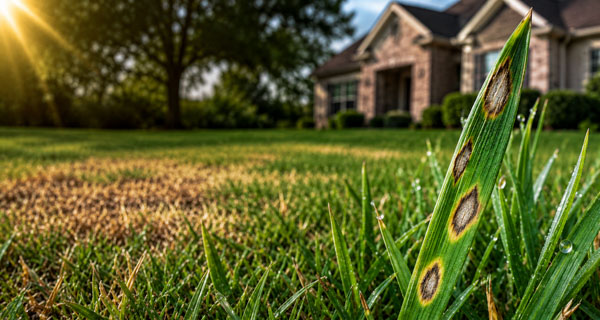
- Small brown or ash-colored spots on individual grass blades, which is how it starts
- Diamond or oval-shaped lesions that grow larger as the infection spreads
- Withered or dying leaves where lesions have developed on the stems
- Expanding dead patches, where what started as a few spots grows into bare areas fast
The lesions often appear gray in the center with darker brown borders, which is where “gray leaf spot” gets its name.
The tricky part is that gray leaf spot looks a lot like drought stress or chinch bug damage at first glance. Homeowners water more, wait for it to bounce back, then it gets worse. That’s usually when we get the call.
If the damage isn’t improving with watering and you’re in a warm, rainy stretch, switch to morning watering and give us a call. Chances are it’s fungal.
According to the Texas A&M AgriLife Extension, gray leaf spot is one of the most common fungal diseases affecting St. Augustine grass during periods of warm temperatures, high humidity, and prolonged leaf wetness.
At CitiTurf, we typically see gray leaf spot outbreaks increase during humid summer weather across Plano, Frisco, McKinney, Allen, Prosper, and surrounding Collin County communities. Because St. Augustine is so common in North Texas neighborhoods, it’s one of the fungal diseases we diagnose most often during the growing season.
Why Lawn Fungus Spreads So Quickly
The fungus thrives when your lawn stays wet longer than it should. A few common habits that make it worse:
- Watering at night, because grass that goes into the evening wet is a perfect environment for fungal growth
- Watering too frequently, because your lawn needs time to dry out between cycles
- Poor drainage or compacted soil, because standing water and soggy areas give the fungus exactly what it needs
- Over-fertilizing an already infected lawn, because high-nitrogen fertilizer on infected turf feeds the problem instead of fixing it
You can’t control the weather. But you can control when and how you water, and that makes a bigger difference than most people realize.
After treating thousands of North Texas lawns over the past 20+ years, we’ve found that nighttime watering is one of the most common factors contributing to fungal outbreaks.
How CitiTurf Treats Gray Leaf Spot
We commonly treat gray leaf spot in Plano, Frisco, McKinney, Allen, and surrounding Collin County communities. When we see it, we move on it fast so the disease has less time to spread.
Here’s what the treatment looks like:
- Professional fungicide treatment: We apply a liquid treatment using proven fungicides that stop the spread at the source.
- Liquid iron blend: We mix in iron to help your lawn recover faster once the fungus is under control.
- Full yard coverage: We treat all grass types, from St. Augustine to Zoysia. If you have Bermuda areas you’d like us to skip, just let us know.
Before recommending treatment, we inspect the lawn to rule out common lookalikes such as chinch bug damage, drought stress, and other turf diseases.
One thing worth setting expectations on: the fungicide stops the active spread. That’s what it’s designed to do. The visible recovery of the damaged areas comes afterward, through sunlight, proper watering, and time. CitiTurf serves homeowners in Collin County and nearby areas, and we’ll walk you through exactly what to expect for your lawn.
Related Resources
From the CitiTurf Blog:
- Brown Patch Disease: Signs, Causes & Symptoms
- Chinch Bug Damage in North Texas Lawns: What to Look For and What Helps
- How to Get a Great Lawn in North Texas
CitiTurf Services: