
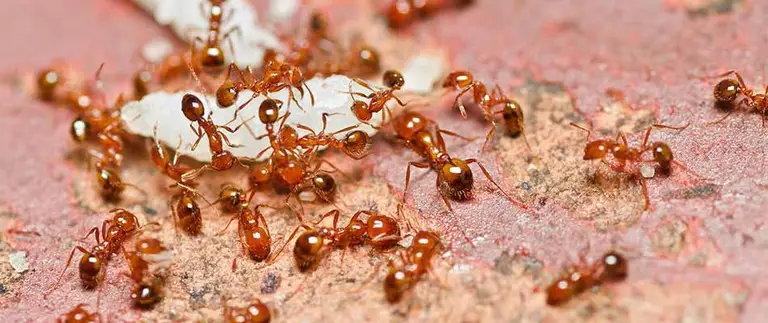
While most “red ants” in North Texas lawns are red imported fire ants, not all of them are. In fact, there are a few other helpful (and some not-so-helpful) “reddish ants” that live here too.
And so, as you’re scraping the internet at odd hours for answers to fire ants vs. red ants, what you’re really wondering is if this is a true nuisance or a simple inconvenience.
We’ve been servicing Collin County yards from Plano to Frisco and McKinney for over 20 years. What we’ve found is the easiest tell is to look at the size, mound shape, worker behavior, and sting symptoms for better clues.
Are Fire Ants and Red Ants the Same Thing?
Short answer? Fire ants and red ants aren’t the same thing.
A “red ant” is a nickname, not a species; whereas, a fire ant is one specific type of ant.
Oftentimes, North Texas homeowners refer to the red imported fire ant (Solenopsis invicta) as the “red ant.”
Without diving too deep, the red imported fire ant was introduced to the United States from South America in the 1930s and is now common across much of Texas.
Because of this overlap, fire ants vs red ants is a common question many homeowners face. But it’s important to note that “red ant” can also refer to other species of ants too, such as:
- Red harvester ant
- Native fire ant
- Or another small reddish ant
All you really need to know here is that the red imported fire ant looks reddish, but a reddish ant doesn’t necessarily mean it’s an imported fire ant.

Fire Ants vs. Red Ants at a Glance
If you only remember one thing, just remember you can’t identify an ant by color alone. Imported fire ants have a combination of traits that is much more useful than whether they look red.
According to Texas A&M’s fire ant identification guidance, imported fire ant workers vary noticeably in size within the same colony, usually from about 1/8 to nearly 1/4 inch long. Their mounds also tend to lack the obvious center entrance you see with many other lawn ants.
| Feature | Red Imported Fire Ants | Other Reddish Ants / Look-Alikes |
| Size | Workers range from very small to about 1/4 inch. | Varies by species; red harvester ants are noticeably larger. |
| Color | Usually reddish brown with a darker abdomen. | Can be red, reddish brown, red-black, brown, or darker. |
| Size variation in one colony | Yes. Workers of several sizes are common. | Often more uniform, although some species have distinct major and minor workers. |
| Nest / mound differences | Loose soil; usually no obvious opening in the center. | Many species have a visible entrance, crater, cleared area, or protected nest site. |
| Bite or sting | Bites to grip and can sting repeatedly. | Depends on species. Some bite, some sting, and some do both. |
| Aggression | Often rushes out quickly when a mound is disturbed. | Varies. Many are less aggressive around the nest. |
| Treat or leave alone | Usually treat in lawns and high-use areas. | Identify first. Some native ants can often be left alone if they are not creating a safety issue. |

Red Ants in North Texas That Are Not the Same as Imported Fire Ants
In North Texas, there are several reddish ants that make homeowners stop and look twice. Some are large and obvious. Others are close enough to imported fire ants that you may need to watch their behavior or mounds before identifying them.
If you’re comparing red ants vs fire ants, these are some of the look-alikes worth knowing.
Red Harvester Ants
Texas A&M describes red harvester ants as one of the larger, more noticeable ants found in open areas of Texas. They’re much bigger than imported fire ant workers, and their nests often have a noticeable cleared or bare area around a single entrance.
Keep in mind, red harvester ants aren’t harmless and can sting. Which means, you don’t want nests in play areas or beside walkways.
The difference between fire ants and red ants like harvesters becomes easier to see once you stop focusing on color.
Generally speaking, harvester ants are:
- Bigger
- Worker ants are uniform in size
- Nest entrance is much easier to spot
Native Fire Ants
Did you know, Texas has native fire ant species too?
Texas A&M AgriLife Extension specifically cites the tropical fire ant (Solenopsis geminata) as a native fire ant. And to the naked eye, it can look very similar to a red imported fire ant.
One clue is worker shape. Tropical fire ant colonies can have a few noticeably larger workers with broad, square-looking heads. Imported fire ant workers vary in size too, but they don’t have that same oversized head shape.
This is one reason the difference between red ants and fire ants is not always something you can settle from a quick photo. When the ants are small and the mound looks similar, proper identification might require a closer look.
Other Reddish Ants Found Around North Texas Lawns
Pyramid ants and bigheaded ants are two more examples of lawn ants that may cause confusion. Pyramid ants can look red-black or dark brown, while bigheaded ants have major workers with heads that look oversized compared with the rest of the body.
Their nests can help. Pyramid ants usually build a small crater around a visible entrance. Bigheaded ants often nest under rocks, landscape timbers, patio blocks, or other protected areas.
In other words, red ants or fire ants isn’t a question you can answer from color at a distance. Look at the mound, the mix of worker sizes, and how the ants react when the area is disturbed.
Why Color Alone Is a Poor Way to Identify an Ant
Color is one clue, but it’s a weak one.
Red imported fire ants are usually reddish brown with a darker abdomen. However, lighting, soil, worker size, and the ant’s moving pace can change what you think you see.
Other Texas ants can be reddish, brown, red-black, or somewhere in between. That’s why fire ants and red ants get mixed up so often.
A better identification check is to ask three questions:
- Are the workers different sizes?
- Does the fire ant mound lack a center opening?
- Do the ants rush out aggressively and climb upward when the mound is disturbed?
This combination of factors tells you much more than color ever will. If the answer to all three is yes, imported fire ants make for a more likely culprit.
Fire Ant Stings vs. Other Red Ant Bites and Stings
A fire ant sting usually burns right away, and the ant may sting more than once. Fire ants first bite to get a grip and then use the stinger at the rear of the body.
Although the more useful clue shows up later. Mayo Clinic – Insect bites and stings: First aid says fire ants form a small white, fluid-filled pustule at the sting site within about a day. This reaction is strongly associated with imported fire ant venom.
Other reddish ants can bite or sting too. For example, red harvester ants can deliver a painful sting. In other words, pain by itself doesn’t answer the fire ants vs red ants question.
If you have trouble breathing, swelling away from the sting site, dizziness, or another severe reaction after an ant sting, seek immediate emergency medical care.
Not Sure Which Ant Is in Your Lawn?
If you’re still wondering what ant you’re dealing with, start by looking at the mound and the ants around it.
Look for things like: loose soil without a clear center entrance; workers of several different sizes; and a fast aggressive response when the mound is disturbed from a safe distance. See our fire ant mound identification guide for more in-depth detail.
Once you know you’re dealing with imported fire ants, treatment is usually worthwhile around lawns, patios, play spaces, and other areas where people or pets spend time. Check out our guide on how to get rid of fire ants to see the treatment approach in more detail.
Considering professional services? CitiTurf offers pest control and fire ant control for homeowners throughout Collin County and nearby North Texas communities.
Related Resources
From the CitiTurf Blog:
- How to Identify Fire Ant Mounds in North Texas
- 3 Things You Should Do if Fire Ants Have Infested Your Lawn
- Pest Control in North Texas: A Homeowner’s Complete Guide