

Your grass is thin no matter how much fertilizer goes down. You water, and it runs straight off into the gutter. Somebody at the HOA meeting swears you need to dethatch. Your neighbor says aerate. So which is it: aeration or dethatching?
They can’t both be right, at least not for your yard.
Aeration vs dethatching really comes down to one question: where is the problem? Aeration opens up packed soil under the grass. Dethatching rips out the mat of dead stems and roots sitting on top of it. Pick the wrong one and you’ve spent a Saturday fixing something that wasn’t broken.
We see this every spring and fall across Collin County. Our clay soil cracks like a dry riverbed in August and turns to glue when it rains, and that’s hard on any lawn. Here’s how to check yours, and what Bermuda, St. Augustine, and Zoysia actually need.
Quick Answer: The difference between aeration and dethatching is simple. One fixes the soil, the other fixes what’s on top of it. Around here, it’s almost always the soil. Blackland Prairie clay packs tight, so most Collin County lawns need aeration, not dethatching. If a screwdriver won’t push more than about 2 inches into damp soil, aerate. Only dethatch if your thatch layer is over 1 inch.
Aeration vs. Dethatching at a Glance
Aeration treats the soil. Dethatching treats the layer above it.
Here’s the difference between aeration and dethatching in a nutshell:
| Core Aeration | Dethatching | |
| What it fixes | Soil compaction | Excessive thatch |
| How it works | Hollow tines pull plugs of soil about 2–3 inches deep | Spinning blades or tines slice into the turf and lift out dead stems and roots |
| Signs you need it | Hard soil, puddles, runoff, thin grass in high-traffic areas | Spongy feel, thatch layer over 1 inch, water beading on the surface |
| What it leaves behind | Small soil plugs that break down in 1–2 weeks | Piles of debris that need to be raked up and hauled off |
| Stress on the grass | Low to moderate | Moderate to high |
| Best time in North Texas | Late spring to early summer, or early fall while grass is still growing | Late spring through early summer |
| How often | About once a year for most clay-soil lawns | Only when thatch is over 1 inch, which may be every few years or never |
| Best fit | Bermuda, St. Augustine, Zoysia | Bermuda (best candidate), Zoysia (light dethatching), St. Augustine (rarely needs dethatching) |
First, Find Out What Is Wrong With the Lawn
Don’t rent a machine yet. Ten minutes in the yard with a screwdriver and a trowel will tell you more than any guess.
Test the Soil for Compaction
- Grab a long screwdriver, 6 inches or more.
- Push it into the lawn by hand in 4–5 spots. Hit the high-traffic areas too, like the strip by the gate where the dog runs.
- Pay attention to how far it goes and how hard you’re pushing.
Do this the day after a rain or a good watering, since dry clay feels like concrete no matter what. Slides in several inches? You’re probably fine. Stops dead around 2 inches in a few spots? That’s compaction.
Blame the clay soil. Most of Collin County sits on Blackland Prairie clay, made of tiny, flat particles that stack together like a deck of cards. Mowers, dogs, kids, even a hard spring rain will press it tighter.
Packed soil means roots can’t dig down and water can’t soak in. The grass ends up living in the top inch, and it shows by July.
Measure the Thatch Layer
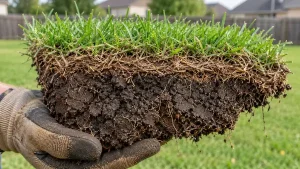
Thatch is the spongy mix of living and dead stems, runners, and roots between the green blades and the dirt. Some of it is good. It cushions the lawn and holds moisture. Too much of it, though, and it works like a tarp.
- Cut out a small wedge of turf about 3 inches deep with a trowel or sharp knife.
- Pull it up and look at it from the side.
- Measure the brown layer between the soil and the green.
What your measurement means:
- Under ½ inch: Normal. Leave it alone.
- ½ inch to 1 inch: Keep an eye on it. Texas A&M AgriLife notes that excess thatch can keep water and oxygen from reaching roots and encourage disease.
- Over 1 inch: That’s excessive thatch. Time to make a plan.
Check 3–4 spots. Thatch is almost never even from the front yard to the back.
When Aeration Is the Better Choice
When soil is the problem, aeration is the answer. You’ll aerate when:
- Your lawn failed the screwdriver test
- Water doesn’t soak into your lawn
- Grass is thin or bare
- Your home is new or had recent construction
Core aeration uses hollow tines to pull out finger-sized plugs of soil, about 2–3 inches deep and a few inches apart. Each hole is a channel for air, water, and fertilizer to reach the roots.
Leave the plugs on the lawn. They look messy, but rain and mowing break them down within a week or two.
Skip spike aeration since it pushes soil sideways instead of removing it, packing clay even tighter.
For most North Texas lawns on clay, aerating once a year is a good rhythm. And if you’d rather have a professional handle it, our lawn aeration service uses core aerators that pull real soil plugs.
When Dethatching Is the Better Choice
For most North Texas homeowners, you won’t need to dethatch, but here’s what you’ll look for in those rare instances:
- Thatch layer is 1 inch+
- Lawn feels spongy or bouncy
- Mower scalps random spots
- Water beads up and runs off
- Grass browns faster in heat
A dethatcher (i.e., a power rake, vertical mower) uses spinning blades to slice into the turf and pull out dead material from the lawn.
The lawn will look rough for 2–4 weeks while it recovers, which is the biggest tradeoff when weighing dethatching vs aeration.
Dethatching is hard on grass. On a lawn with a normal thatch layer, it tears up healthy runners for no reason. Only do it when your measurement says you need it.
What If Your Lawn Needs Both Aeration and Dethatching?
Most North Texas lawns benefit more from aeration than dethatching. But if your lawn truly needs both, schedule lawn aeration and dethatching while the grass is actively growing. Dethatch first so the aerator can reach the soil.
Aeration or Dethatching for North Texas Lawns?
Your grass type changes whether you need aeration or dethatching. Here’s how our three most common lawn grasses in North Texas handle each treatment.
Bermuda Grass
Bermuda spreads above ground through stolons and below ground through rhizomes. Its fast growth can also contribute to thatch buildup.
But on the bright side? It also handles dethatching best and bounces back quickly.
In spring, scalping Bermuda also clears out a lot of the dead material that turns into thatch. Here’s how our team does it:
- Best timing: Late spring to early summer.
- Aeration: Once a year.
St. Augustine Grass
St. Augustine spreads using thick, wide runners on top of the soil with no backup rhizomes underground. In most cases, dethatching isn’t recommended for St. Augustine because it can damage it.
Texas A&M AgriLife explains that both core aerators and verticutters can be used to thin thatch. For St. Augustine, core aeration is usually safer for compaction and mild thatch.
Zoysia Grass
Zoysia is dense and slow-growing. It can handle light dethatching, but it takes weeks longer than Bermuda to recover.
When it comes to dethatching vs aeration for Zoysia, aeration is usually the better pick. Aerating once a year helps keep thatch from building up in the first place. If you need to dethatch, wait until late spring when the lawn is fully green, and make light passes rather than one big one.
Not Sure What Your North Texas Lawn Needs? Check Before You Treat
Here’s the whole process in five steps:
- Test for compaction
- Measure thatch
- Rule out other problems (shade, watering, grubs, disease)
- Match the fix to the problem
- Time it right
During the fall, late October is too late to dethatch any warm-season grass in North Texas. The lawn won’t have time to recover, and torn-up turf gives winter weeds an easy place to sprout. Fall is a great time to run your tests, though, so you have a plan for spring.
Still not sure where your lawn lands on aeration vs dethatching? Get a quote and our team will take it from there. CitiTurf serves Plano, Frisco, Allen, McKinney, Wylie, and the rest of Collin County, and every visit is backed by our Peace of Mind Promise. Call or text us at 972-516-0001.
Related Resources
- Do I Need to Aerate My Lawn in Texas Every Year?
- The Best Time to Aerate Your Lawn in Plano, TX
- Why Are There Clumps of Soil on My Lawn After Aeration?
- The Clay Soil Barrier: Why Fertilizer Fails on DFW Lawns
- Lawn Scalping in North Texas: When, Why, and How to Do It Right
CitiTurf services: